
 Posted by
 Iran’s threats to Gulf water infrastructure are real and it’s worth thinking potential consequences through.
Israel and every Gulf country other than Iran and Iraq obtain 80% or more of their drinking water supplies from desalination facilities that are often co-located with power plants and which would offer high payoff targets to Iranian forces.
Amidst a media focus on potential talks mediated by Pakistan and other countries, many pieces of potential a new escalation cycle are moving into place, including additional US ground forces and aircraft. Accordingly, it makes sense to concretely assess how kinetic action might harm a desalination plant.
Nature gives us an example. Most of the world’s desalination capacity is in the Gulf Region—which does not typically suffer major natural disasters. Desalination facilities have also thus far not been systematically targeted in war. Amidst this (thankfully) sparse library of facility damage events, the Kurnell Tornado stands out as especially relevant.
Three Years to Rebuild From a Tornado
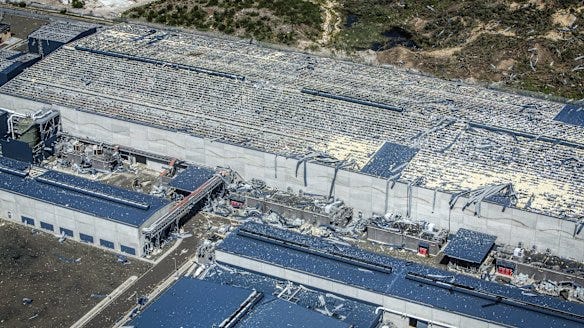
On 16 December 2015, a supercell thunderstorm near Sydney, Australia spawned an EF-2 tornado that passed over the Kurnell Peninsula with winds estimated to have reached at least 132 miles per hour. The twister did not cause any serious human injuries but left major property casualties—foremost among them the Sydney Desalination Plant, which lost several building roofs and a control room. It took nearly 3 years to make the plant capable of water production again.
Aerial View of Tornado Damage to the Sydney Desalination Plant
The Tornado-Missile Relationship
This tornado event is arguably the most valuable “natural experiment” we have for understanding what a missile or drone strike does to a modern desalination plant. It proves that you don’t need to level the facility to achieve a “mission kill.” The damage profile mirrors the effects of a “near-miss” or a debris strike from an intercepted missile.
Physics render the comparison remarkably direct: the Kurnell Tornado was producing an amount of near-ground wind energy equal to about 125 kg of TNT. The energy comparison is not fully apples-to-apples because it is kinetic energy and fluid dynamics versus explosive energy. Nonetheless, it suggests that as a matter of magnitude, the impact of an Iranian short range ballistic missile or a few Shahed drones could inflict similar damage.
In other words, even a single Iranian munition leaking through a layered air defense screen can plausibly cause this type of damage to a desalination plant. The threat is credible.
The Appendix section at the end of this essay outlines the calculations behind this number.
What the Tornado Exposed (And That Iranian Missiles Could Also Do)
The Control Room as a Single Point of Failure: The tornado didn’t hit the plant’s “industrial guts.” It hit near the administrative/control area. If the “brain” is exposed to the elements (or fire), the “body” of the plant—no matter how modular—cannot properly function.
Debris as Shrapnel: At Kurnell, roof sheeting was found kilometers away. Modern plants are often just “metal sheds” over high-tech equipment; they have zero “hardening” against high-velocity metal.
The “Long-Lead” Item Trap: You can’t buy a massive high-pressure pump or a custom SCADA motherboard off the shelf. Thermal desalination plants require large, interconnected steel vessels that would have to be forged by an already stretched global supply chain. Reverse osmosis components also take significant time to procure.
Rebuilding could take years. Even if systems could be repaired in weeks or months through heroic wartime measures, key cities’ water storage would still likely be strained to the point that significant economic activity shutdowns or even civilian evacuations would be required.
There are a range of solutions that can help bolster GCC countries’ water resilience, including additional water storage, a hydrovascular grid with more pipeline interconnections, and supply projects aimed at obtaining water from multiple sources (Persian Gulf, Red Sea, and Arabian Sea). A subsequent post will explore these in detail.
Conclusion
If a single tornado can cause multiyear damage to a desalination plant, a concerted military assault with large, fast, explosive munitions could be far more destructive. Moreover, military attacks would likely target multiple facilities simultaneously as well as power plants. The risk of cascading failures would be significant.
Kurnell shows that you don’t have to destroy a desalination plant to win against it. You only have to hit it in the right place.
In the Gulf, where cities run on desalinated water, that reality turns water systems into strategic pressure points. A handful of successful strikes could impose long-term disruptions and also scare off investors.
The critical variable is not how much damage is done—it is how long the system stays down.
Suggested Citation: Gabriel Collins, “What a Desalination Plant “Mission Kill” Looks Like: Lessons from the Kurnell Tornado,” The Sinews of Civilization, Substack, 25 March 2026. https://gabrielcollins.substack.com/p/what-a-desalination-plant-mission
Thanks for reading The Sinews of Civilization: Fire, Food, Water, Force! Subscribe for free to receive new posts and support my work.
Appendix
Here’s how I calculated it—a tornado is a cylindrical mass of very rapidly rotating air. Therefore, calculating its volume and multiplying that number by the density of air on the Kurnell Peninsula, which basically sits at sea level, yields a mass estimate. Then, taking that mass and multiplying it by ½ and then the square of wind velocity (60 meters/second) yields an estimate of the kinetic energy in the maelstrom hitting the facility.
The volume of a cylinder is πr2h. I assumed the relevant portion of the cylinder was the first 25 meters above ground level—where the damage was being wrought. Further, using Google Earth to measure the machinery hall that lost its roof suggests the core damage path had a radius of approximately 55 meters.
Thus, π X (55 meters)2 X 25 meters equals 237,583 cubic meters. Multiplying that by 1.229 kg per cubic meter of air yields 291,989 kg of air. If that air is moving at 60 m/s, the calculation ½ X Mass X Velocity2 yields approximately 526 megajoules. That is the equivalent of about 125 kg of TNT.
 Texas Water Intelligence