
 Posted by
 Looming water shortages threaten not just local households, but crude and LNG supply chains vital to the Texas and global economies.
Corpus Christi may soon confront something most large American cities have never experienced: running out of water. The risk carries major local human consequences. It also would bring national energy consequences because Corpus Christi hosts one of the largest concentrations of crude export terminals, refineries, and LNG infrastructure in the United States.
The City of Corpus Christi itself now expects physical shortages to commence as soon as 8-9 months from now. If this scenario even partially manifests, the human and economic consequences could be enormous. If the shortages endured into 2027, Imagine Winter Storm Uri or Hurricane Harvey-type impacts but over a potentially much longer period of time.
The economic and political decision-making that led to this point is beyond the scope of this article and is well-covered by other sources. What has been less covered is the chain of consequences that can unfold if a sustained water shortage takes hold.
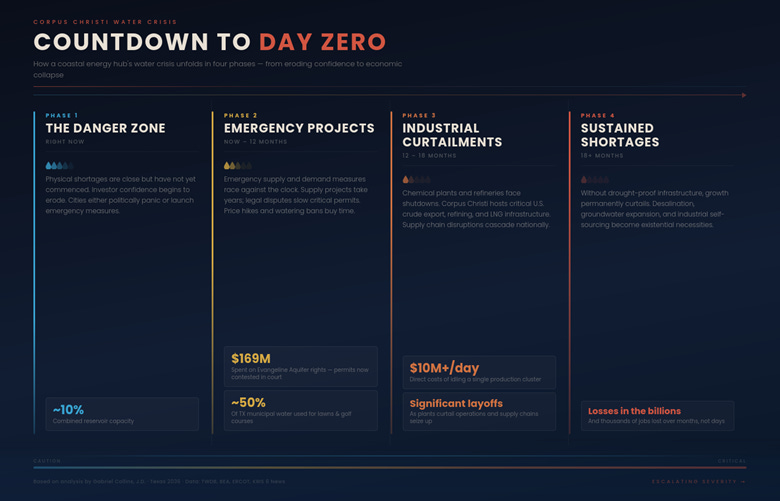
Counting Down to Day Zero: How a Water Crisis Unfolds
Phase #1: The Danger Zone (right now)
This is where Corpus Christi finds itself now. Physical shortages are close at hand but have not yet commenced. This is the phase where cities and utilities either politically panic or else launch emergency measures to balance supply and demand of water. It is also the phase where investor confidence begins to erode.
Phase #2: Emergency Projects (now to 12 months from now)
As physical shortages loom, cities and utilities can take action to balance supply and demand. The supply side takes the longest. Most water supply projects take years to design, permit, and build. There are exceptions.
A. Emergency Supply Projects
In 2012, the City of Midland faced serious water supply shortfalls during the 2011 Drought. As part of its response, the Midland County Fresh Water Supply No. 1 worked with private engineering contractors to develop a wellfield at the T-Bar Ranch and a pipeline to move the water approximately 60 miles to Midland. This project was completed within 10 months.
Corpus Christi faces a more challenging situation. Pending permit issuance, the city has committed to purchase approximately 23,000 acres of Evangeline Aquifer groundwater rights north of town for $169 million in fall 2025. The tract was originally intended to produce more than 28,000 acre-feet per year of groundwater that could be transported into Corpus Christi’s water treatment system using the existing Mary Rhodes Pipeline. This is enough water to supply 75,000 households, assuming monthly use of 10,000 gallons per rooftop. It doesn’t fill the full water supply gap but it would help a lot.
But there’s a problem: the groundwater transport permit needed to move the water from the San Patricio County Groundwater Conservation District’s jurisdiction to Corpus Christi is now being legally contested. Given the lead-time needed to acquire key water production equipment such as high-capacity pumps, each day of additional legal contestation makes it less likely that the City can have these supplemental water supplies online by November 2026, a key inflection point at which physical shortages may commence.
Midland’s limiting factor in 2012 was how fast contractors could design and build a wellfield and pipeline. That meant moving at the speed of business. Corpus Christi’s limiting factor in 2026 is legal. That means moving at the speed of litigation. Water demand and drought almost always move faster than legal process.
B. Emergency Demand Responses
Supply responses take time because they often require building new infrastructure. Demand side responses are much faster—but also often much scarier for elected officials. This is because the most rapid demand responses take one of two fundamental forms: price increases to disincentivize water use or decree-based use restrictions.
Texas cities facing water crises within the past 15 years have employed both strategies to try and reduce water demand. In 2012, Midland’s city council unanimously approved a five-fold increase in water prices for any usage beyond 10,000 gallons per month. Water usage subsequently declined significantly, and in combination with the T-Bar project described above, helped maintain water security.
Wichita Falls, which faced an even more serious water shortage during the 2011-2015 period, imposed restrictions on lawn watering, car washing, and other non-human consumption uses of water. Depending on the velocity of a water crisis, price and regulation-based approaches can free up water for the most critical needs by inducing consumers to jettison things like watering lawns.
At least one study suggests nearly half of municipal water use statewide in Texas comes from keeping golf courses and lawns green. Corpus Christi residents used an average of 61 gallons per day per person in Fiscal 2024. With approximately 500,000 consumers on the city system, a price-induced reduction of 10% would save approximately 3 million gallons per day—75% of the supplemental groundwater volume the city is fighting to bring online by November 2026.
If emergency supply and demand measures fail to close the gap, the next stage becomes unavoidable: industrial curtailment.
Phase #3: Industrial Curtailments (12-18 months from present)
Water shortages affect manufacturing activity through either outright physical water deprivation or else, through disruptions to electricity.
Insufficient water supplies can force output reductions or even outright shutdowns at industrial facilities like chemical plants, which can have water use requirements equal to, and sometimes exceeding, those of medium-sized municipalities. An extant example comes from the Altamira industrial complex in Mexico, where for several months beginning in May 2024, several large petrochemical and chemical plants had to curtail operations and, in some cases, temporarily shut down and declare force majeure due to insufficient water supplies in the local system caused by extreme drought conditions.
The chemical industry’s annual contribution to the Texas economy exceeds $50 billion, meaning that each 1% of production curtailment by value would cost nearly $1.5 million/day.
Idling facilities in a key production cluster like that found near Corpus Christi could impose direct costs of $10 million or more per day, with larger downstream effects on a range of supply chains given the plants’ vital global role, a phenomenon illustrated by impacts caused when plants on the Texas Coast went offline during Winter Storm Uri in 2021.
Uri inflicted total losses on the Texas economy of between $80 and $130 billion, a material portion of which stemmed from disruptions to industrial output. In addition to economic costs, unscheduled startup and shutdown procedures caused by water or power availability challenges can amplify safety risks for workers and fenceline communities. Large chemical production facilities have a complex operational homeostasis that can be seriously disturbed by input supply problems.
Phase #4: Sustained Shortages (18 months from now and beyond)
For Corpus Christi, what if there were no hurricanes or tropical storm impacts for 5 more years? Under normal circumstances, the response would be “that sounds great!” But for a place whose surface water supplies have run so low that a hurricane is now viewed as a potential water savior, a different reaction arises: time to build long-term, drought-proof water supply infrastructure or else suffer a potentially permanent curtailment in growth, prosperity, and human wellbeing.
Conclusion
Groundwater supply expansion, desalination projects for brackish groundwater and seawater, and demand management will all be part of the solution portfolio.
It is also extremely likely that utilities and municipalities in the Corpus Christi area will need to push industrial customers to self-source more of their water supplies through captive desalination facilities or else pay significant portions of the capital cost to expand and upgrade municipal water systems. That approach would be fairer and more sustainable for municipal ratepayers.
I’ll be writing in much more depth on these issues in coming weeks.
Suggested Citation: Gabriel Collins, J.D. “Corpus Christi’s “Day Zero”: What Happens When a Coastal Energy Hub Runs Out of Water,” The Sinews of Civilization, Substack, 9 March 2026. https://gabrielcollins.substack.com/p/corpus-christis-day-zero-what-happens
 Texas Water Intelligence