

 Posted by
 Original Post available on Substack at: https://gabrielcollins.substack.com/p/the-real-bottleneck-for-ai-infrastructure
A rural water well owner, a county commissioner, other elected officials, and a development team seeking to build a gigawatt scale data center that needs several million gallons of water a day are in a room. This isn’t the start of a poorly told joke—it’s actual reality in parts of Texas and elsewhere. And the punchline is often fear and a desire to slow data center construction down.
America’s Digital Forge (aka data centers) can challenge local water supplies and power grids. As such, residents’ concerns are incredibly legitimate and deserve full and serious policy attention.
There is real space for solutions that reinforce our AI edge while protecting local livelihoods: Water is generally local and can be engineered out of operations. Power is non-negotiable for running chips. It is generally regional and comes from expensive generation and transmission assets with complex permitting processes and stressed supply chains.
Let’s put the numbers in perspective. In 2024, Google’s global data center fleet likely consumed roughly twice as much electricity as the entire city of Austin, Texas—a city of a million people and a major tech hub in its own right. Yet the company required only about 1/5 as much water. The overwhelming majority of this electricity and water was used in data centers.Subscribe
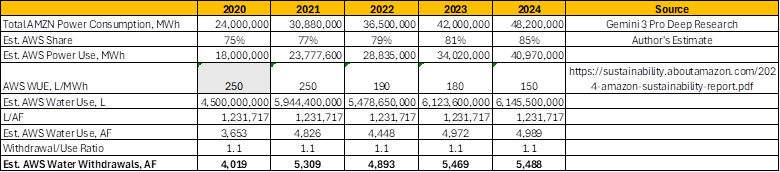
Indeed, pulling data from Google, Meta, and Microsoft’s latest sustainability reports and adding an estimate for AWS (table at end of article), suggests that globally, the hyperscalers withdrew a volume of water roughly equivalent to what the Vista Ridge Pipeline supplies to San Antonio each year.
This volume is material—especially for folks living near data centers or sharing small and medium-sized water systems with one. Yet it is also one that is highly surmountable with well-crafted policy. We’ll offer an actionable idea in the final section of this analysis.
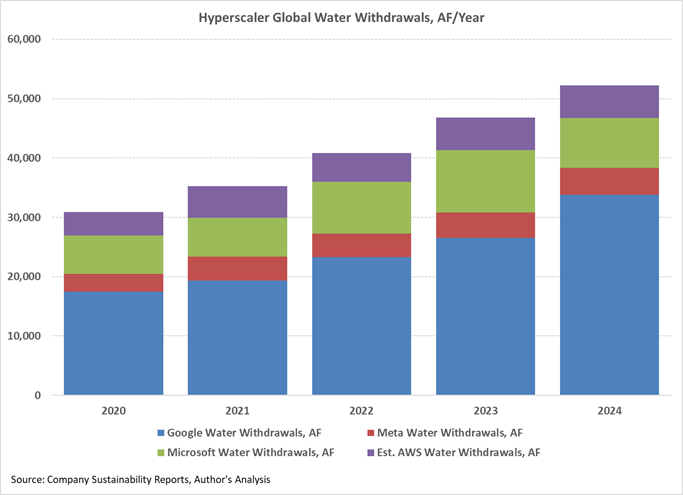
The quantities of both electrons and H2O are big but the 10:1 ratio already hints strongly that power is likely a more severe challenge than water. This is a core point that the current data center discussion misses: water problems are localized whereas power grid issues are regional, if not multi-state. The corollary to this is an important one: power generation issues can cost anywhere from hundreds of millions of dollars to billions of dollars to fix. Local water issues can be fixed at far lower cost .
Power Can’t Be Engineered Out of Data Centers
You need electrons to run chips. Power use can be optimized with algorithmic innovation and perhaps also hardware changes. But it cannot be engineered out of the system. Electrons make the trillions of transistors on each chip perform the computing work that processes datasets, emails, memes, and everything else our silicon servants do for us.
But Water Can Be, To a Significant Extent
Water is different. Data centers need cooling. If you use evaporative cooling like an old-school thermal power plant, you’ll need lots of water. Especially in hot places like Texas. But there are other options. First are the physical engineering options like air-cooling. Hyperscale data center developers can –and are–contracting around water constraints by using unconventional resources like reclaimed wastewater.
There is also another option: invest in local water systems so that if you do have to draw down local groundwater, folks have an alternative option. This is not just a data center issue: it can also potentially help resolve concerns about groundwater export projects that transport water from rural aquifers to thirsty cities. Rural water systems are much more expensive per customer than a water pipeline network serving a densely populated urban area. But the absolute cost pales in comparison to a hyperscale data center project.
Consider the following data points: a cutting edge AI data center can cost $25 million per MW to build. That means $25 billion in capital investment for a gigawatt of computing capacity. In contrast, a rural water system’s total installed capital asset base might be worth $50 to $70 million—0.28% of the data center’s starting capital value.
If a grid constraint binds, hundreds of millions to billions in capital must be deployed to solve it. If a local water constraint binds, tens of millions may solve it.
This suggests that in water-stressed areas, a data center that for operational reasons needs groundwater access could build a local water system (the “Google Water Co-Op” model) or else inject a capital contribution into an existing provider to help it ensure supply resilience and connect additional customers to the system so they do not have to depend on individual wells.
Greater use of air cooling and more substantial financing of rural water systems by data center operators are two key issues that I expect will come up in the 2027 Texas Legislative session. If we misdiagnose the constraint, we will apply the political brakes for the wrong reasons and risk our current global AI leadership. When we solve for water via capital, the punchline changes from fear to shared prosperity.
Thanks for reading The Sinews of Civilization: Fire, Food, Water, Force! Subscribe for free to receive new posts and support my work.Subscribe
Suggested Citation: Gabriel Collins, “The Real Bottleneck for AI infrastructure Isn’t Water. It’s Power,” The Sinews of Civilization, Substack, 19 February 2026. https://gabrielcollins.substack.com/p/the-real-bottleneck-for-ai-infrastructure
AWS Water Withdrawals Estimation Model
 Texas Water Intelligence